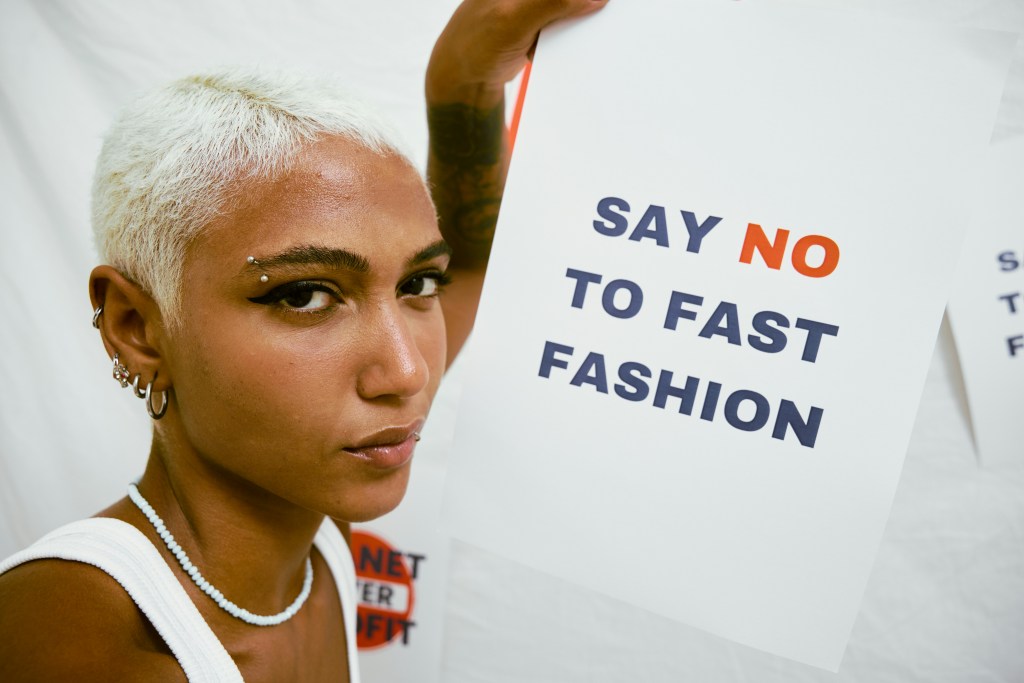
New York Fashion Week is underway, and if you have been reading the coverage or walking the shows, you already know which two words have taken over the conversation. Sustainability is no longer the worthy side panel at the end of the schedule. It is the main claim on the runway — recycled fibers, plant-based silks, experimental textiles presented not as compromises but as the point. And standing directly opposite it, named more openly each season, is fast fashion and the waste it leaves behind.
It is a genuine argument, and it is being staged under the lights. But it is not being settled there. The question of how much a brand overproduces, how much it discounts, how much it destroys, and how much it can prove about any of it is settled months earlier, in the systems where the buy is planned, the materials are chosen, the factory is booked, and the inventory is counted.
Waste does not begin at the landfill. It begins at a forecast made at the wrong level of detail, a sample cycle that ran four rounds too long, a container that became an air freight bill, and a season-end position nobody saw coming until it was already sitting in a warehouse.
CKS Cloud Solutions + Dynamics 365 BC + K3 Pebblestone

Overproduction Is a Data Problem Wearing a Sustainability Costume
Ask a fashion operator where the waste in their business actually lives and the answer is rarely exotic. It lives in the styles that were cut in sizes and colors the market did not want, in the goods that moved only at forty points off, in the deadstock that never found a channel, in the duplicate development work that happens when nobody can find the last tech pack.
Every one of those is an inventory and information failure before it is an environmental one — which is precisely why the sustainability argument and the efficiency argument have quietly become the same argument. Unsold inventory destroys margin and generates waste in the same motion. There is no version of this where a brand runs leaner and pollutes more.

What has changed in the last two years is that this is no longer a matter of conviction. It is becoming a matter of filing. Under the EU’s Ecodesign for Sustainable Products Regulation, the destruction of unsold apparel, accessories, and footwear has been prohibited for large companies since July 19, 2026, with medium-sized enterprises following in 2030 — and from February 2027 those large companies must disclose what they discarded, in what quantities, why, and where it went, in a standardized format. France’s environmental scoring requirement for garments moves from voluntary to mandatory this autumn, with penalties that scale to revenue.
California’s Responsible Textile Recovery Act has producers registering with a state-approved producer responsibility organization. The EU’s textile EPR framework arrives across member states by 2028, with fees deliberately weighted against products that are hard to recycle and lighter on those built to last and be repaired.
Read that list as an operator rather than as an advocate and a pattern appears. Every one of these regimes asks the same thing: item-level fact, produced on demand. Composition. Origin. Supplier. Quantity made, quantity sold, quantity left, and what became of it. That is not a story a marketing team can write. It is a query — and it either runs against your operational records or it does not run at all.
The brands that will struggle are not the ones without a point of view.
They are the ones whose point of view lives in a deck while their actual product data lives across eleven spreadsheets, a PLM trial, and the memory of one very tired production manager.

Where Business Central and K3 Pebblestone Do the Unglamorous Work
This is the part of the fashion supply chain conversation that never makes the runway recap, and it is the part our clients actually live in. Microsoft Dynamics 365 Business Central with K3 Pebblestone is fashion ERP in the literal sense: the apparel-specific capability is embedded in the financial and operational system rather than bolted alongside it. That single detail is what makes waste reduction measurable instead of aspirational, because the sustainability numbers and the P&L numbers come out of the same records.
The mechanics matter more than the messaging:
- Variants in a matrix, not a guess. Planning a style is not planning a garment. Color and size combinations managed in a proper variant matrix let brands forecast, buy, and replenish at the level where waste is actually created — the SKU that sold through and the one that never moved.
- Collections, seasons, and delivery drops as real objects. When the calendar is structured in the system, pre-booking and allocation can drive production toward committed demand rather than optimism, and NOOS programs keep the carry-forward styles available without a speculative overbuy.
- PLM that shortens the road from idea to approved sample. Fewer development rounds mean fewer physical samples, less courier freight, and material decisions made once with the right information.
- Sourcing visibility with landed cost. Seeing the logistics chain from order placement through final delivery, with true landed cost attached, is what keeps a late order from becoming an air freight emergency — the single most expensive and most carbon-intensive way to recover from a planning miss.
- Supplier compliance and CSR credentials held as data. CSR rules defined to match your own agenda, with supplier performance and compliance tracked against them, turn due diligence into a record you can produce rather than a claim you have to defend.
- Multi-location inventory control. Stock you can see across locations and regions is stock you can move to a channel that wants it, which is the difference between reallocation and a markdown — or a bonfire that is now illegal.
None of that is a sustainability module. It is ordinary operational discipline that happens to produce the exact artifacts regulators, retail partners, and increasingly customers are asking for.
Better, faster, smarter, more efficient — and, as a direct consequence rather than a campaign, less wasteful.

The Season After This One
The most useful thing to take from this week is that sustainability has stopped being a values question and become a capability question. The brands making credible claims are the ones who can answer follow-up questions, and the ability to answer follow-up questions is an infrastructure property. Somewhere between the runway and the reporting deadline sits an ERP decision, and it is arriving faster than most mid-market fashion brands have planned for.
If your team is looking at the 2027 disclosure calendar and quietly wondering where the data will come from, that is the right instinct, and this is the right year to act on it. We implement Business Central and K3 Pebblestone for apparel and footwear brands, and we are happy to walk the specifics of your product, planning, and sourcing process before anyone talks about a platform.
The industry spent a decade learning how to talk about sustainability. This season it begins having to document it. What a brand can audIT, it can improve; what it can commIT to, it can defend; and a system that fITs the way a season actually runs is the only kind that survives one.
Increase sustainability. Reduce waste. Our fashion back-office can do IT.
CKS Cloud & Fashion/Apparel
CKS Cloud works across the whole fashion and apparel chain — manufacturing, import and export, distribution, wholesale and retail, e-commerce, and model agencies. That vantage point means we see a single season from several sides at once: the production calendar, the customs paperwork, the warehouse, the sales floor, and the storefront.
It’s also why we pay close attention to weeks like this one. Shows are where the industry says out loud what it intends to do next; the market floor is where it commits. Watching both tells us where demand is heading, what is shifting in sourcing and compliance, and where the pressure is about to land on our clients’ operations.
We put that back into the fashion solutions we build and support — and into helping our clients plan, adapt, and run stronger businesses, season after season.



Leave a comment